
Warehouse multi-solutions Orchestration
From managing robots to orchestrating entire warehouses — the new era of automation has one brain!
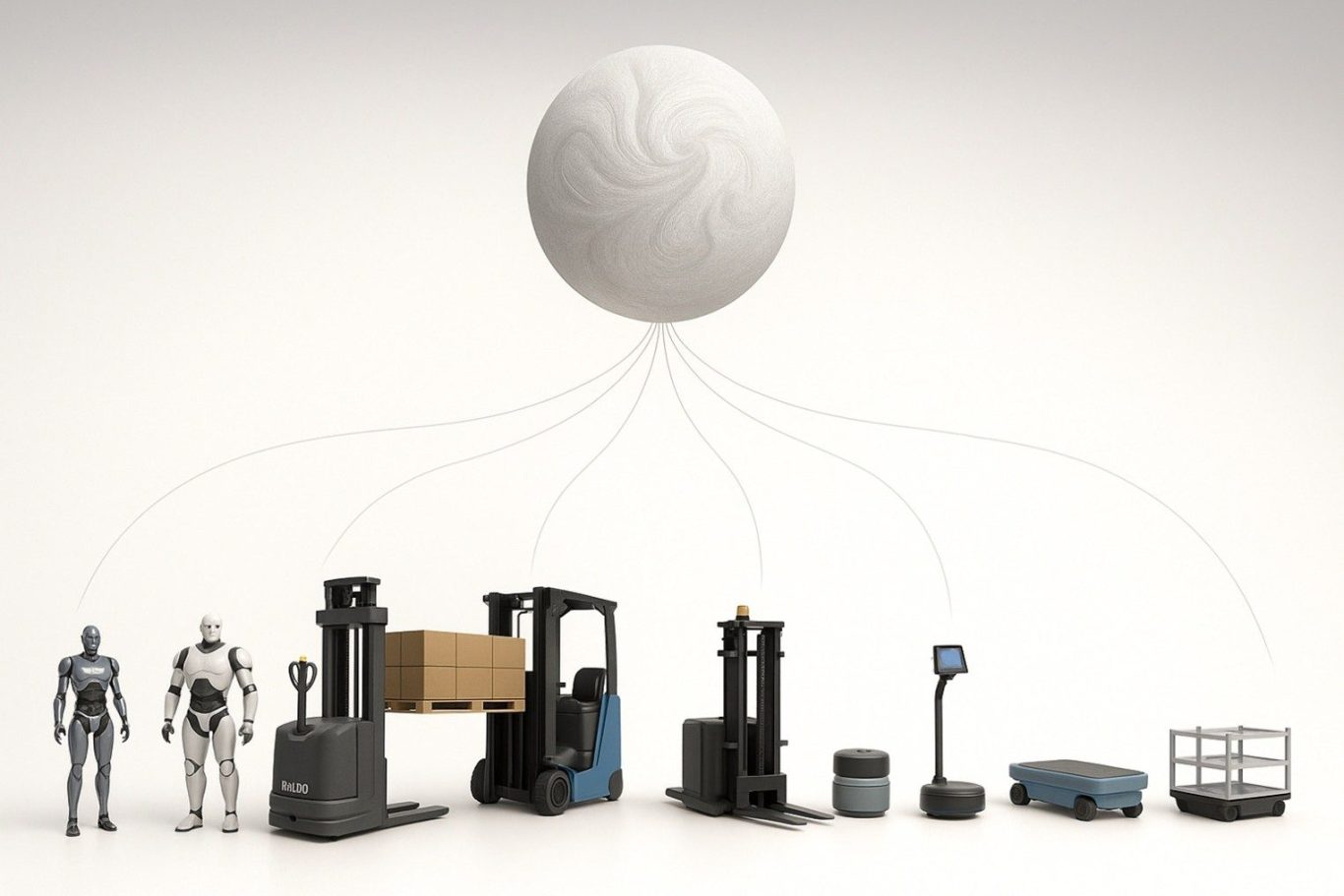
Over the past years, the robotics industry has experienced an increase in innovation within fleet orchestration software for autonomous mobile robots (AMRs). This is a market that continues to develop from one that was once very fragmented, where each robot vendor provided proprietary systems, to a dynamic ecosystem of companies developing vendor‑agnostic orchestration platforms. These solutions allow warehouses, factories, and logistics hubs to manage diverse fleets of robots from different manufacturers under a single software layer, improving efficiency and scalability.
🤖 Companies like BlueBotics, Waku Care, Meili Robots, GreyOrange, and Synaos have emerged as pioneers in the field of AMR fleet orchestration, each with its own focus and strategy. Their work has been instrumental in driving the transition from isolated, vendor‑specific solutions toward open, intelligent platforms capable of managing diverse fleets under a single software umbrella.
What is really important in this transformation is the move towards interoperability and integration. Instead of having to rely on one manufacturer's robots, logistics operators, warehouses, and factories can now deploy mixed fleets, robots from different vendors working side by side, while being orchestrated by a central orchestration layer. This intelligent software doesn’t just assign tasks; it optimizes traffic flow, balances workloads, and ensures that every robot contributes to the overall efficiency of the operation.
And these five companies are not alone. A growing ecosystem of innovators is exploring this very vision:
- Kinexon follows industry‑standard, hardware‑independent orchestration (e.g., VDA 5050) to guarantee seamless communication within heterogeneous fleets.
- Otto Motors focuses on mission‑critical material handling, with its Fleet Manager widely adopted in manufacturing and logistics.
- Siemens integrates orchestration into its Xcelerator suite, enabling smart factories to automate multiple robot types.
- Seegrid uses vision‑guided navigation and fleet management software to optimize warehouse workflow.
Together, these companies have created a new era of robotics characterized by collaboration, flexibility, and intelligence. The capability to orchestrate various fleets in one system is the cornerstone of modern intralogistics, setting the stage for truly autonomous, adaptive, and scalable operations.
🪄 Destro AI
What once was the focal point, transforming mobile robots into commodities, has now moved a step ahead. The attention has shifted from connecting different vendors in the AMRs space, to connecting different solutions under the same umbrella: AMRs, AGVs, conveyors and sorters, robotics, and even ASRS systems, controlled and coordinated with a unique software solution.
Lately I had a conversation with DestroAI, a New York–based company, and it really threw me off. DestroAI is part of a broader trend in multi‑fleet orchestration software, a market growing rapidly (forecast CAGR of 22%+ through 2033 📈). By positioning itself as the “OS for Robotics”, DestroAI is not just competing with companies like BlueBotics, GreyOrange, or Synaos, it’s trying to redefine the category by offering a unified AI layer that makes robots more productive and adaptable.
In a nutshell, what is DestroAI:
🧠 One Brain for Any Robot
- Vendor‑agnostic integration: controls robots from different manufacturers.
- Avoids vendor lock‑in, enabling mixed fleets to scale flexibly.
🤝 Agentic AI Approach
- Robots act as autonomous agents coordinated by a central intelligence.
- Real‑time decision‑making, traffic optimization, and collaborative execution.
🛠️ Solving Industry Pain Points
- Tackles expensive labor, slow fulfillment, fluctuating demand, and productivity challenges.
- Ensures SLA compliance and throughput improvements across workflows (material handling, picking, transport).
📡 Scalability & Readiness
- Designed as a general‑purpose AI operator for robotics.
- Scales beyond logistics into manufacturing and other automation‑heavy sectors
DestroAI represents the next generation of orchestration platforms, moving well beyond traditional fleet management into AI‑driven, workflow‑centric automation. While many existing solutions focus on scheduling tasks and preventing collisions, DestroAI is building a general‑purpose AI operating system for robots, a layer of intelligence that not only coordinates movement but also understands and optimizes the entire workflow of a warehouse. And it goes one step further, offering plug‑and‑play modules for specific use cases.
📦Use Case: Carton Picking per Order-Pallet in B2B environments
One of the most pressing challenges in business‑to‑business (B2B) logistics is the efficient assembly of order‑pallets. Unlike B2C e‑commerce, where single‑item orders dominate, B2B fulfillment often requires picking multiple cartons of different SKUs and consolidating them into a single pallet destined for a retailer, distributor, or production line. It’s a typical situation in shop replenishment, where accuracy and speed are critical.
How DestroAI Addresses This Challenge?
DestroAI’s orchestration platform enables collaborative carton‑picking strategies:
⚡Worker–Robot Collaboration:
- Workers remain in designated zones, focusing on picking accuracy.
- Robots handle transport, eliminating the need for workers to push carts or walk long distances.
- Results in 2× higher throughput and reduced physical strain.
🔄 Dynamic Workflow Optimization:
- The software continuously analyzes order data, warehouse layout, and robot availability.
- Robots are dynamically assigned to pick tasks, balancing workloads and minimizing congestion.
- Multiple robots can collaborate on the same pallet, each delivering different cartons.
🔗 Integration Across Systems:
- The orchestration layer connects AMRs with conveyors, sorters, and ASRS systems.
- Ensures cartons flow seamlessly from storage to palletization.
- Reduces bottlenecks and accelerates pallet completion.
🎯 Accuracy & SLA Compliance:
- Centralized orchestration reduces mis‑picks and ensures pallets match order specifications.
- Faster fulfillment helps companies meet strict service‑level agreements (SLAs) in B2B contracts.
🌍 Scalability Across Sites:
- The same carton‑picking logic can be replicated across multiple warehouses.
- Enables standardized workflows and faster scaling for global operations.
🧬The Bigger Picture
This carton‑picking use case shows how DestroAI goes far beyond simple fleet management. It doesn’t just move robots, it synchronizes entire warehouse ecosystems, ensuring AMRs, conveyors, and ASRS systems collaborate to fulfill complex B2B orders. By doing so, it transforms carton picking from a bottleneck into a competitive advantage, enabling companies to handle fluctuating demand with agility, precision, and scalability.
What do you think, is this the path forward? I’m certain it is, and we’re only getting started.