
Automating the Non Standard
Why Industrial Logistics Breaks Every “Flexible” Automation System
For years, automation vendors have sold the idea that their systems are “flexible.” And they are, as long as you operate inside market standards. But in industrial logistics, “flexibility” usually means one thing:
You can automate anything you want, as long as it fits in a 600×400 mm tote, weighs less than 30 kg (50 kg if you’re lucky), has a barcode, and behaves like a retail SKU.
The problem is simple: industry doesn’t work like retail.
And this is why most automation projects collapse the moment they leave the world of standard boxes and predictable flows.
Here are real operational cases that reveal how the problem actually unfolds on the warehouse floor.
1. Vehicle Assembly: The Electric Cable Problem
In automotive assembly, electric cable harnesses arrive just in sequence, and every car configuration is different.
This means different box sizes, different weights, different geometries, different suppliers, different packaging standards
Try automating that with a system designed for identical totes.
A “flexible” AMR fleet that requires 600×400 mm containers or 800x1.200 mm pallets is useless when half the inbound flow arrives in irregular boxes that don’t fit the standard footprint.
💪 A robotic picking arm trained on perfect cartons fails instantly when the item is a soft, tangled cable harness.
This is not an exception, it’s the daily reality of industrial logistics.
2. Furniture Logistics: IKEA Is the Exception, Not the Rule
Furniture is a perfect example of non‑standard chaos:
- pallets of different sizes.
- long, bulky, fragile, or heavy items.
- packaging that varies by supplier.
- SKUs that don’t fit into any standard container.
The only reason IKEA is automated is because IKEA forced the world to standardize around IKEA. Suppliers had to redesign mechanics, pallet formats, and even product geometry to fit IKEA’s automation.
But outside IKEA?
🛋️ Most furniture operations still deal with 1.200×800 mm pallets, 1.000×1.000 mm pallets, 2.400 mm long items, irregular shapes, mixed inbound loads and no comparable volumes to Ikea.
There is no automation system on the market that can handle this diversity without massive custom engineering and massive cost.
3. Large Item Picking: Pipes, Bumpers, and the Ergonomics Nobody Talks About
Industrial warehouses routinely handle items that are 1.5 to 3 meters long, 10 to 40 kg, awkward to grip, deformable, sharp, or fragile.
Picking a bumper or a long pipe is non‑ergonomic, slow, dangerous, impossible to standardize. And yet, there is no commercially viable automated solution for this category unless you spend millions on custom robotics, in industries where margins are often single‑digit.
Humans still do the heavy, awkward, risky work. Not because automation is “not mature,” but because automation is not designed for non‑standard geometry.
🤖 This is exactly where humanoids might finally matter. Not because they look like us, but because they are being built for the kind of tasks that don’t fit into a tote, a gripper, or a predefined workflow. Their value isn’t the shape of the robot, it’s the software stack behind it: perception that can interpret messy, unstructured environments, manipulation that adapts to irregular objects, and whole‑body control that can handle long, heavy, unbalanced items.
Humanoids won’t replace humans in these tasks tomorrow. But for the first time, there is a category of robotics that could eventually take on the large, awkward, non‑standard items that every industrial warehouse struggles with, the tasks that traditional automation has ignored for decades.
4. Automatic Truck Unloading: The Mixed Container Nightmare
Every automation vendor loves to show a demo of automatic truck unloading. But the demo always looks like this: identical cartons, snake‑loaded, stable, aligned, within a narrow weight range.
Now compare that to industrial inbound reality:
🚚 A container arrives with hundreds of different carton sizes, no alignment, no snake loading, no stability, no consistency, no labeling standards, no predictable weight distribution.
Try unloading that with a robot. The system fails because industrial inbound is not a flow, it’s just a pile of mixed, unpredictable goods.”
The Core Truth: Retail Is Standard. Industry Is Not.
🛒 Retail logistics works because the product has been engineered to fit the system.
🏭 Industrial logistics fails because the system tries to force standardization onto a world that is fundamentally non‑standard.
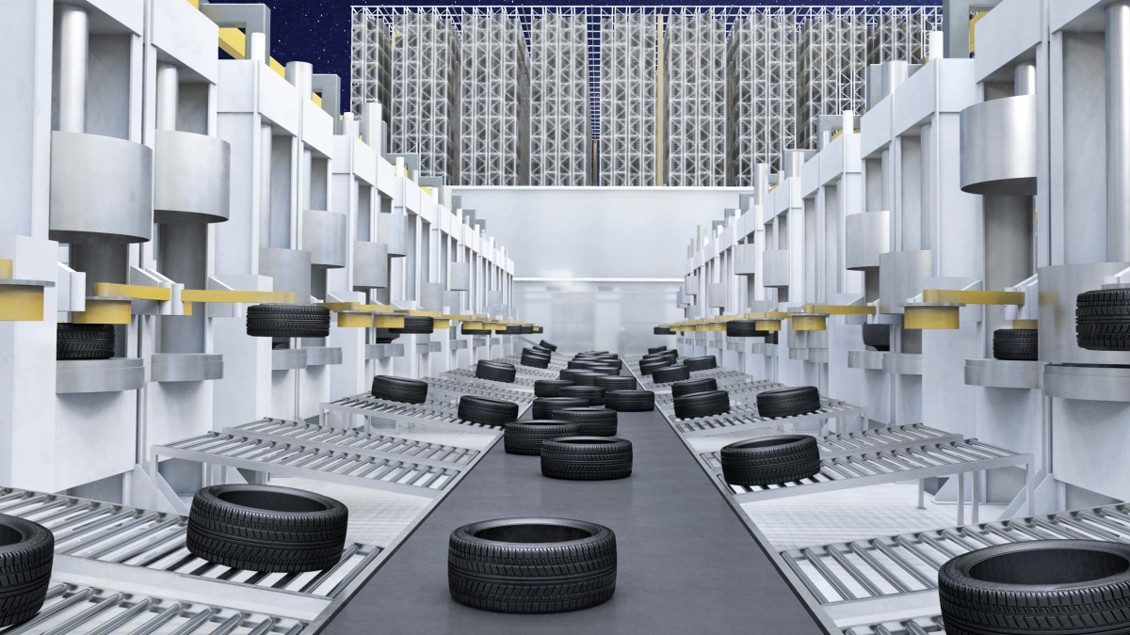
A few industrial verticals have solved this (ceramics or tires, for example) but they remain the exception. Despite the weight of their products, they’ve standardized all inbound and outbound materials to their own format.
Automation built for retail collapses in industry because the physical reality is incompatible with the assumptions baked into the technology.
On one side, retail operates with ~95% tote compatibility, predictable packaging, low weights, high volumes, and low variability, and suppliers follow the rules. On the opposite side, industry operates with ~40% (or less) tote compatibility, irregular packaging, heavy items, low volumes, high variability, and supplier‑driven chaos.”
➤ Conclusion: The Future of Automation Is Not “More Robots”, it’s Handling the Non‑Standard
The next frontier of automation is not faster AMRs or smarter WMS. It’s systems that can handle:
- irregular geometry
- unpredictable packaging
- heavy items
- mixed pallets
- mixed containers
- non‑ergonomic picks
- supplier variability
- real‑world chaos
Until automation can deal with the non‑standard, industrial logistics will remain a human‑dominated domain. And that’s the truth nobody in the automation industry wants to say out loud.
🏢 Vendors Tackling the Non‑Standard (and Worth Watching)
A few companies are genuinely pushing into the non‑standard domain, not perfectly, but meaningfully: Fives, Gideon, Servus, legacy robots integrators of Kuka, ABB or Fanuc, Cimcorp, and many others...
None of these companies has fully cracked the non‑standard problem, but they are among the very few actively confronting it instead of pretending it doesn’t exist. And they’re just examples, not a complete list. The field is broader, and new players are emerging as the challenge becomes impossible to ignore.