
The Hidden Cost Drivers of Automation: What Vendors Don't Tell You
Understanding the Full Economic Landscape of Modern Warehouse Automation
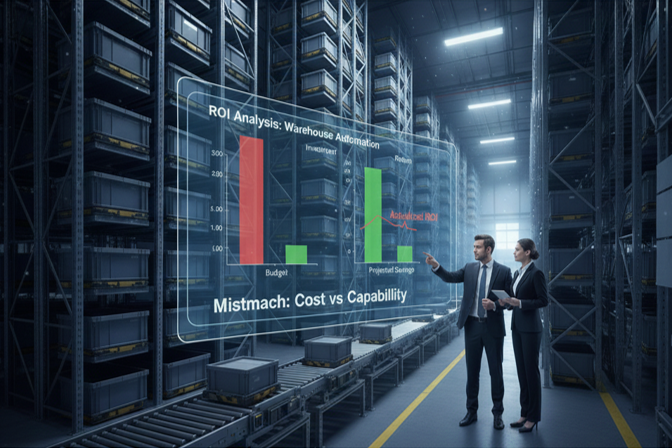
Automation is no longer a futuristic ambition in logistics. It’s a strategic necessity. Despite the promises of flawless robots, seamless orchestration, and double‑digit ROI, most automation projects end up costing more and delivering less than expected.
After twenty years working across the entire automation value chain, from manufacturers and system integrators to consulting firms and end‑customers, I’ve seen the same pattern repeat itself in every market and every technology cycle. Executives don’t fail because they lack ambition, they fail because they underestimate the invisible layers of cost, complexity, and operational maturity required to make automation work at scale.
This article exposes the cost drivers’ vendors rarely mention, the blind spots that make projects derail, and the framework leaders should use to evaluate automation with clarity instead of optimism.
📦The Integration Tax: The Most Expensive Line Item You Never See
Every automation vendor claims “easy integration.” None of them define what that means. Integration is the point where costs escalate far beyond initial expectations.
Why integration costs explode
- Every robot, ASRS, AMR fleet, or humanoid requires its own API layer.
- Legacy WMS/WCS systems were never designed for real‑time orchestration.
- Data models between systems rarely match.
- Middleware becomes a patchwork of custom logic.
- Testing cycles multiply with every new interface.
The result is predictable: Integration becomes a multi‑month engineering project disguised as a line item. And once you’re integrated, you’re locked in. Which leads to the next hidden cost.
🧠Software Lock In: The Silent ROI Killer
Automation vendors don’t sell hardware, they sell ecosystems. In the moment you adopt a proprietary fleet manager, a robot OS, or an orchestration layer, you are committing to:
- Their update cycles
- Their pricing model
- Their roadmap
- Their limitations
Vendor lock-in transforms warehouse operations into isolated, proprietary environments where switching becomes cost-prohibitive. The underestimated factor for many executives is focusing on the capital expenditure of the robot, while the true long-term financial burden lies in the operational software subscriptions.
📌Fire safety, Insurance, and Regulatory Compliance: The Forgotten Budget Line
This is the cost category almost nobody anticipates and the one that can stop a project entirely. Automated warehouses introduce new risks:
- High‑density storage
- Lithium‑ion batteries
- Charging zones
- Reduced human presence
- Complex evacuation scenarios
- New ignition sources
Standards like NFPA 13, ISO 6182 or EN 12845 were not written with AMRs, ASRS, or humanoids in mind. Insurers know this and they price the uncertainty accordingly. Executives often discover:
- Sprinkler redesigns
- Water supply upgrades
- Compartmentation changes
- Additional detection systems
- Higher insurance premiums
These can add 10–25% to the total project cost. And they are non‑negotiable.
🔄Process Redesign: Automation Without Re‑Engineering Is Automation of Inefficiency
Automation does not fix broken processes. It amplifies them. Most warehouses attempt to deploy automation without redesigning:
- Slotting logic
- Inbound flow
- Exception handling
- Replenishment cycles
- Picking strategies
- Shift patterns and more
The result is predictable: Robots wait for humans. Humans wait for robots. Material flow becomes constrained. The real cost isn’t the redesign, it’s the operational downtime and the months of tuning required to stabilize the system.
🤝 Operational Maturity Gaps: The Human Factor Nobody Wants to Discuss
Automation requires a different type of workforce:
- Operators with data analysis capability
- Robot technicians
- Software supervisors
- Automation managers
- Process analysts
Most organizations don’t have these profiles. They underestimate the cost of hiring, training, retaining, and managing the change that comes with automation. Automation fails not because robots malfunction, but because organizations do.
📉Why ROI Models Fail Before the Project Even Starts
Most ROI models are built on assumptions that collapse under real‑world conditions:
- Throughput is calculated at theoretical maximums.
- Uptime assumes perfect maintenance.
- Labor savings assume full substitution, not partial.
- Maintenance costs are underestimated.
- Peak season variability is ignored.
- Exception handling is treated as negligible.
The result is a ROI model that looks impressive on a slide deck and unrealistic in an actual warehouse.
🧬The Executive Blind Spots That Derail Automation Projects
Executives consistently underestimate:
- The time required to stabilize automated systems
- The operational discipline needed to maintain them
- The complexity of multi‑vendor orchestration
- The impact of automation on fire safety and insurance
- The long‑term cost of software dependencies
- The cultural resistance inside their own teams
Automation is not a technology project. It is a transformation project.
⚡Conclusion: Automation doesn’t Fail, Expectations Do
Across two decades working with manufacturers, integrators, consultants, and end‑customers, one truth has remained constant: automation rarely fails because of the technology itself. It fails because leaders underestimate everything around it.
When these blind spots converge, even the most advanced automation struggles to deliver on its promise. The companies that succeed are not the ones that buy the most robots, they are the ones that approach automation as a transformation project, not a procurement exercise. They invest in process redesign, operational maturity, safety compliance, and long‑term system governance. They understand that automation is an ecosystem, not a machine.
Automation can absolutely deliver resilience, scalability, and competitive advantage. But only when leaders confront the hidden costs, challenge optimistic assumptions, and build the organizational foundations required to support it.
🤖The future of logistics will be automated. The winners will be the ones who prepare for it with clarity, discipline, and realism.
Are we investing in automation, or are we truly preparing our organizations to operate it?